Monday, March 22, 2021

PSA - Toxic and Hazardous Waste Water Pollution

Toxic and Hazardous Waste 

A Water Pollution Public Service Announcement


Hazardous waste:
Don't drink poisonous water! Hazardous or toxic waste eventually ends up in our water.  By taking simple steps in recycling toxics and proper disposal methods we can reduce pollution and protect our water systems. Hazardou waste is 
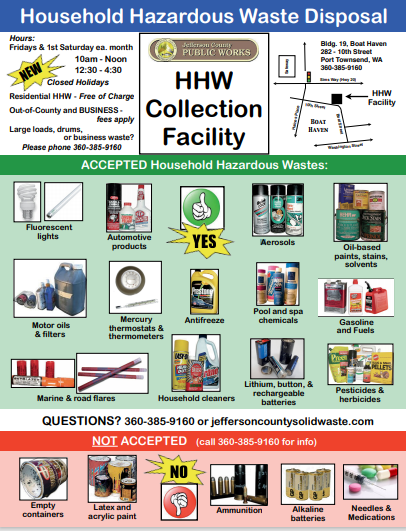
Some examples include pesticides, automotive fluids, fluorescent light bulbs, rechargeable batteries, some household chemicals, mercury, oils, and fuel.

Consequences:
Hazardous waste gets on the ground.  It can contaminate the soil, which could also contaminate the groundwater or nearby surface water.  Many household products, fertilizers, and pesticides contain hazardous chemicals.  These can travel through the soil and contaminate groundwater.  Many consumer products can contain toxic chemicals and in many cases there are less toxic alternatives you can choose from.

Less toxic chemicals are better for your health and safer around your home and family. More toxic chemicals can irritate skin, cause breathing problems, and poison children and pets.

How you can prevent water pollution:
Read and follow signs to conserve or save water, post more signs around your neighborhood, take your toxic wastes to the county dump station, or you could join an earth day volunteer project to help clean up your local area.

The county dump has a hazardous waste disposal program that identifies toxic waste and how to dispose of it. 

Make up signs to post around your community with a message that reminds residents that storm drains dump directly into their local water source, make a poster about ways to save water at home like turning off the water when you're brushing your teeth or only running the dishwasher when you have a full load.

People can choose safer products.  Look for products that have an EPA Safer Choice logo, used to indicate the products that meet US EPA safer product standards.  Products with this label use the safest ingredients, and are just as effective as other similar products.  Products to choose from that can be less toxic include, all-purpose cleaners, bathroom cleaners, degreasers, soaps, and laundry detergents.

What's A Solution:
My solution is to post signs around our local towns and community areas.  Simple reminders will show and tell people of possible  water pollution problems.  Signs telling people how to dispose and recycle waste will reduce pollution in our soils and water systems.  Many signs are available telling people how to conserve water, help not waste water, and stop water pollution.


What I want to do is to share available information about the county's waste program to let people know how to handle toxics and household waste.  I can also make up informative posters out of cardboard or sign poster material.  I would use markers, glue, stickers, and tape to decorate and create colorful information boards. With help communities can learn how to manage solid and hazardous waste.  They can also choose to use less toxic chemicals in the products we use.  By learning proper disposal methods for the everyday household products and using more green practices we can protect our valuable water resources. 

Here is an example of the Jefferson County Solid Waste household hazardous waste disposal flyer.  127862_HHW facility_WEB (wordpress.com)

Sources:
Source Water Protection (SWP). Easy Things You Can Do To Protect Drinking Water Source.
https://www.epa.gov/sourcewaterprotection/easy-things-you-can-do
Cleveland Clinic.  Household Chemical Products and Their Health Risk.
https://my.clevelandclinic.org/health
Washington State Department of Ecology.  Publications and Forms. Wastes and Toxics.
https://ecology.wa.gov
Jefferson County, WA – Solid Waste Program
https://jeffersoncountysolidwaste.com/
Jefferson County Solid Waste. Hazardous Waste Flyer.
https://solidwaste.files.wordpress.com/2020/04/2020-hhw-facility-flyer.pdf

By Charli T

Growing Food Polluting?

 FARMING POLLUTION 

  
What if I told you fertilizing our crops/lawns is hurting our environment? Well, when we fertilize our lawns and crops we can be polluting flowing water. When you fertilize your lawn the water is lifting the fertilizer and carrying the fertilizer into the nearest water source. Then the fertilizer is polluting that water source.


One out of the many water sources affected by farming is the Mississippi River. The Mississippi River is now brown because of all of the pollutions from farming. The turbidity levels of the Mississippi River would be terribly high. The tap water from most Mississippi homes is toxic and isn't safe to drink or use. 
                                                     
I did an experiment to see how we can fix this pollution problem. This slideshow is the process (if you can't see the slideshow below, click here):


Why do you value water? Well, think about it March 22nd is National water day. I value water. My family always hits the water in the summer we water, ski wakeboard, tube and etc. We even have a pool. The time I value water is with my family. That's why water means so much to me. Think about it some of your best memories could be in the water or you could value good drinking water. If you value water why are you helping pollute it? 
#WorldWaterDay #Water2Me
  

We can fix this problem and we will!!! 


Bibliography 


Thursday, March 18, 2021

Oil Spills? Get a Vacuum

 PSA


Oil Spills:

Oil spills happen a lot around the world and it is horrible for the ocean. Oil spills happen when oil tubes explode and the oil from the ocean goes all over. When oil tubes explode they suck the oil out of the ground in the ocean and just keeps going until it gets fixed. Once it gets fixed they have to make sure that it has no cracks and they have to make sure that the machine is still working because it has been smothered in oil. Once they fix it they have to go into deeper parts of the ocean to get animals and clean them off and take them in so they don’t get into more oil.

Consequences:

The consequences are that all the sea life in that ocean dies because they get smothered in oil.

If all of our sea life dies then we can’t have calamari or fish. All the people that get protein from seafood will have to eat the out of the ordinary food (What I mean for out of the ordinary is that it is not normal for “Them”). Seafood is very healthy for us and can give us protein and if we don’t have that source of protein then we will have to eat more of other animals like cows, pigs etc. If we eat more of those animals then we will run out because we have eaten so much that we will not have the time to breed them for more cows. We will just eat them.


How can we help:


Us humans can help by putting types of machines out in the water to clean up the oily water and we could also make the oil tubes stronger so they do not spew out any oil when it blows up. Another way we could help is that we have eyes on the oil tubes 24/7 like scuba divers will go into the ocean and check it all out before setting a camera somewhere and some people watching the video like a security camera. Another way we could make sure that oil spill don’t happen we could protect the tube with more metal, and plastic around it so if the first layer cracks we can still have 2 more layers to break through and the time it would break the other layers we would have it completely fixed up,

My Solution:

My solution is that we put a machine called the (Swasher) and it cleans the oily water like this:We do that except with oil. The machine will have little holes that water can go through but the oil particles will stay in there. The water will be pressed down through the small holes. It will be all the stuff that sea water will only have in it and not oil. Once the water is completely pushed out the oil particles will go into a separate container that sucks it up so the other oil particles will stay in it. This part works like a vacuum: 

Show Your Sources!
Where I learned how a vacuum works and how it is the same as my device is from:https://home.howstuffworks.com/vacuum-cleaner.htm

I got my information about how the oil would be pushed down enough to where it would push the water out and the oil would stay behind:https://www.flickr.com/photos/121935927@N06/13580040284/in/photostream/


How the machine will spray out the water that gets into the oil spot:https://alexanderell.is/posts/check-valve/


By Deken


Lovely Day on the Lake


    It's a lovely bright shining day in Northern Idaho. Your family is visiting Twin Lakes and decides to have a beach day at the lower lake. You walk in the warm sand towards the cool water and a breeze hits your face. You are instantly refreshed when you submerge into the deep water. You dunk your head underwater, only to see the glimmer of toxic metals amongst the sand! You push yourself to the surface and gasp for air and when you open your eyes you see that all around you are rotting disgusting dead fish. It's a lovely day on the lake.


    Thankfully, this isn't what lower Twin Lakes looks like YET. But the mining in areas surrounding the lake will cause this eventually unless something is done. The lower lake connects to many small streams and rivers that carry toxic metals like aluminum and lead from the important mining industries in Northern Idaho. It isn't just Twin Lakes that's affected. Many other large lakes such as Coeur D'alene Lake are suffering from toxic metal pollution as well. But that's not the only problem. Algae blooms are also taking over! Algae blooms are poisonous to fish and wildlife. Something must be done.


    This is an interesting problem because the mining industry is big, important to the economy of Idaho, and provides lots of jobs for people. The community could try and find alternatives to relying on mining for money like working at a supermarket or starting a small business. The Idaho Department of Environmental Quality also has resources for schools, citizens, and businesses to help them cut down on waste and pollution. People can research and join local clean-up groups to try and slow down the pollution, but it's going to take a more creative idea to fix this issue. That's where I come in.


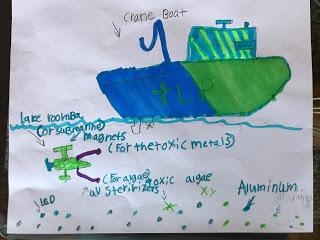
    My solution is called “The Lake Roomba”. It would be a submersible dropped by a crane boat into one of the more heavily polluted areas of lower Twin lake. The submersible would have magnets to magnetically attract the metals, and UV sterilizers and kill toxic algae blooms simultaneously. To make sure it would not go off course there would have to be a programmed navigation system that would have multiple preset routes of the lower lake. Because algae blooms can be killed with at least 4 hours of UV interference, we would have the submersible running for at least 4 hours a day and doing different routes each time for maximum effect.


Citations

Emily Benson Image credit: Jerome Pollos for High Country News June 24, 2019 From the print edition. “A Dangerous Cocktail Threatens the Gem of North Idaho.” High Country News – Know the West, 24 June 2019, www.hcn.org/issues/51.11/pollution-a-dangerous-cocktail-threatens-the-gem-of-north-idaho.

Sarles, Connor, and Connor Sarles. “Health Advisory Issued for Lower Twin Lake Due to Toxic Algae Blooms.” KXLY, 19 Dec. 2019, www.kxly.com/health-advisory-issued-for-lower-twin-lake-due-to-toxic-algae-blooms/.

“Where This Occurs: Lakes and Rivers.” EPA, Environmental Protection Agency, 18 Apr. 2019, www.epa.gov/nutrientpollution/where-occurs-lakes-and-rivers.


Written by Zachary H

What water means to me (to raise awareness to water issues all over the world, the United Nations celebrates World Water Day every year and this year's World Water Day is March 22): 
What water means to me is life. We can't survive without water. We use water to drink, to clean ourselves to wash our clothes, and to power our homes. It must be hard to not have clean water or to not even have it at all.
#Water2Me


Wednesday, May 20, 2020

Minecraft Pollinator Garden

6th Grade Tour of a Minecraft Pollinator Garden


Minecraft Education Edition has created a great activity for students to learn about the importance of pollinators in our world by having kids build an amazing pollinator garden! Sixth grade Science students were able to download the Pollinator Garden world from Google Classroom to use at home with their school Minecraft Education Edition accounts!


Here's what kids see when they first enter the Pollinator Garden world:

Here's what their empty plot looks like before they start building:

And here's a tour from one of our 6th graders who completed his gardens and recorded a tour on the assignment Flipgrid:


Tuesday, May 19, 2020

Ocean Acidification

What is Ocean Acidification?
    Acidification is the process where a substance yields a hydrogen ion when dissolved into water. This means that it gives up the positive hydrogen in its molecular structure and binds with the water. So when CO2 dissolves into the H2O, it forms carbonic acid. And when the hydrogen in the water is yielded, it becomes a bicarbonate ion. But where does the hydrogen ion go? Well, there are lots of particles and other things in water. But the one that shellfish like oysters, muscles, and clams all use to build their shell is called calcium carbonate or CaCO3 which is one calcium, one carbon, and three oxygens. But the hydrogen ion likes the calcium as well and will fight the shellfish and coral for the calcium carbonate. This results in the shellfish trying to find carbonate to build their shells rather than finding places to eat or hide from predators. Anyway, the hydrogen ions are what make the oceanic pH drop and the reason that they’re even in the ocean is because of all of the carbon dioxide that is created when we burn fossil fuels to generate the energy we use to power our lives.


How does it Affect us?

    The United States of America has been one of the first countries to be affected by Ocean Acidification. The Puget Sound has The most corrosive waters in the world. The water that the oysters grow up in is so low pH that they are dying within two days after being raised in it. If that isn't saying we've been hit, I don't know what is. Maybe if our rain was dissolving trees or something, but the water is corrosive enough to dissolve the baby oysters in hatcheries. That's right, the oysters are actually dissolving in the water that they're being raised in. The waters of the Kitsap Puget Sound have made a huge leap in acidification ever since the Industrial Revolution. Upwelling is how most of this acidification happens. One of the processes of this kind of upwelling, is when the ocean plankton absorb the carbon from the air in the water is then getting eaten by fish that live deeper and they’re taking that carbon dioxide even deeper and then upwelling brings all of that extra CO2 and making the surface more corrosive. Upwelling is natural, but when it upwells so much CO2 that it is increasing the oceanic acidity, it's a minor problem.


What can we do About it?


    There are so many things that we could be doing to help stop the climate crisis, but we aren't. The answer to the question, “Who will win, climate change or us?” is determined by two other questions. “Can we power our lives with much less CO2,” and if the answer to that question is yes, then the second question is, “Will we do it?” The answer to the first question is pretty straight forward, of course, we can use less CO2. But the second, the answer depends on a few things. Scientists say that in order to protect the worst effects of climate change, we cannot let our planet warm by over 2 degrees Celsius, and we’ve already almost reached 1 degree. 


And a quick piece of information, the amount of energy you need to warm the entire planet even 1 degree Celsius, or 34 degrees Fahrenheit, is so tremendous compared to how it happens naturally. For the planet to warm naturally like this would require hundreds of thousands to millions of years. And now some things about how energy is generated in the US. In a fuel plant, they have many turbines that are turned by burning fossil fuels that heat up water, and then the water turns to steam, then the steam turns the turbine which generates energy. But there are many other efficient, and Earth-friendly. Like using water and wind to turn the turbine instead. Or, you could pull energy directly from the sun with solar panels. And even some places use the geothermal vents in the earth to power plants and generate electrical energy. These resources are renewable energy sources, unlike fossil fuels which are nonrenewable sources which means that there are a lot of them, but eventually, they will run out.

Comm